Guide · Reviewed by Farah Akram, Dietitian
TDEE vs BMR: what is the difference?
BMR and TDEE sit behind almost every calorie target you have ever been given, and they are mixed up with each other constantly. One is the cost of keeping you alive on a day you never get out of bed. The other is the cost of your actual life, work, steps, workouts and all. Confusing them is not a small rounding error: for many people the two numbers differ by 500 kcal or more, which is the size of a whole meal. This guide defines both in plain language, shows how one is built from the other, runs one person through both numbers, and settles which one you should actually eat to.
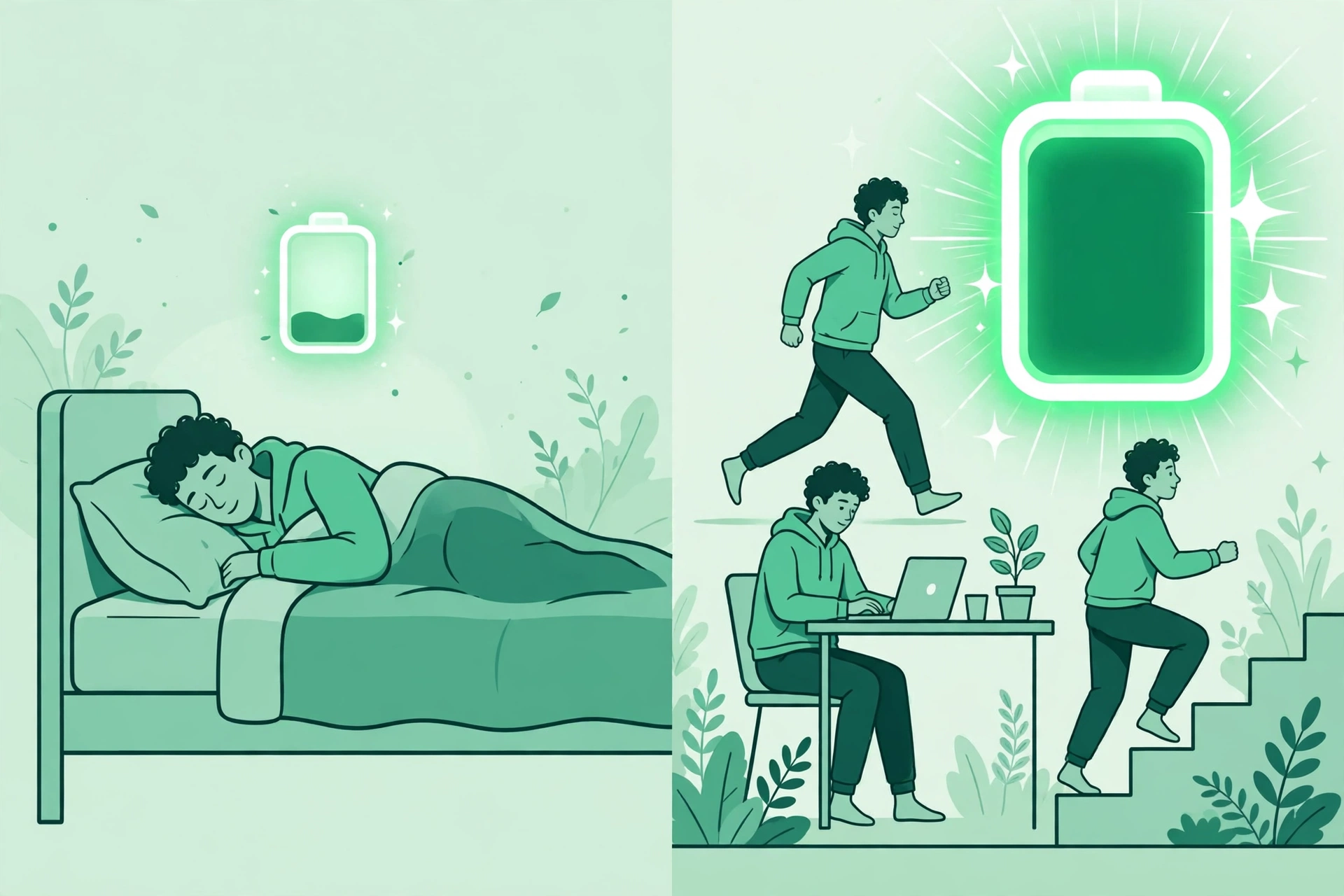
BMR: the cost of staying alive
Your Basal Metabolic Rate is the energy your body spends at complete rest just to keep itself running: your heartbeat, breathing, body temperature, cell repair and brain activity. No walking to the kitchen, no digesting lunch, no fidgeting at your desk. Picture the burn of a day spent motionless in bed at a comfortable temperature, and you have BMR.
It is a bigger number than most people expect. For most adults, BMR accounts for about 60 to 70 percent of everything they burn across a whole day, which means the majority of your energy goes on simply existing. You can change it only slowly: it rises slightly with more muscle mass and falls slightly as you lose weight or get older. The standard way to estimate it is the Mifflin-St Jeor formula, which needs only your sex, age, height and weight. Our BMR Calculator runs it for you in seconds.
TDEE: the cost of your actual day
TDEE stands for Total Daily Energy Expenditure, and it means exactly what it says: every calorie you burn across a full day, BMR included. It has four parts:
- BMR, the resting burn above, usually 60 to 70 percent of the total.
- The thermic effect of food, the energy cost of digesting what you eat, roughly 10 percent of intake.
- NEAT, non-exercise activity thermogenesis: steps, standing, housework, carrying shopping, even fidgeting. This varies enormously between people and is the most underestimated part of the day.
- Exercise activity, your actual workouts, which for most people is a smaller slice than they hope.
Nobody can measure all four parts at home, so calculators fold the last three into a single activity multiplier, from 1.2 for a sedentary lifestyle up to 1.9 for athletes, and multiply your BMR by it. That one step is the entire difference between the two numbers, and our TDEE Calculator does it for you instantly.
The two numbers, side by side
| Question | BMR | TDEE |
|---|---|---|
| What it counts | Resting body functions only | Resting functions plus all movement and digestion |
| Typical size | About 60 to 70 percent of your daily burn | Your full daily burn, 100 percent |
| How it is estimated | Mifflin-St Jeor, from sex, age, height and weight | BMR multiplied by an activity factor, 1.2 to 1.9 |
| What you use it for | A floor and the starting point of every calculation | Setting the calorie target you actually eat to |
One person, both numbers
Take the example used across this site: a woman of 32, 5 ft 6 in tall, weighing 165 lb. Her BMR works out to about 1,475 kcal. That is her floor, the cost of a day spent entirely in bed. Now give her a real life. On desk bound days with little movement, her TDEE is 1,475 x 1.2, about 1,770 kcal. On her usual routine, training three to five days a week, it is 1,475 x 1.55, about 2,287 kcal, the figure our calculator shows. Same body, same BMR, three very different totals depending on the day she is living.
This is why a bare "calories per day" figure quoted without context means so little. The honest number is always BMR plus an honest account of your activity, and the activity half of that sentence is where most of the error creeps in.
Which number do you actually need?
For almost every decision, it is TDEE. To maintain your weight, eat close to your TDEE. To lose weight, eat below it: a deficit of 250 to 500 kcal is the standard starting point, and our Calorie Deficit Calculator turns that into daily targets. To gain weight or muscle, eat above it, usually by 250 to 300 kcal. BMR still earns its place in all three cases, as the sanity floor: a target that falls below your BMR deserves a second look, because you are planning to eat less than your body needs at complete rest.
The common mistake: eating at your BMR
A persistent piece of advice tells people to eat their BMR to lose weight. It confuses the floor with the target. For our example, it would mean eating 1,475 kcal while burning 2,287, a deficit of over 800 kcal a day. On paper the weight falls faster. In real life that usually means strong hunger, low energy, poor training, and a diet that is very hard to keep nutritionally complete, so most people abandon it within weeks. A moderate deficit below TDEE moves the same scale in the same direction, just at a pace you can actually live with.
Reviewed by Farah Akram, Dietitian. Estimates only, not medical advice. See the medical disclaimer.
TDEE vs BMR questions
Is TDEE always higher than BMR?
Yes. TDEE starts with BMR and adds everything else you do in a day, so it is always the bigger number. Even on a fully sedentary day the multiplier is 1.2, which puts TDEE about 20 percent above BMR. The gap grows with activity: a very active person can have a TDEE more than 70 percent above their BMR.
Should I eat my BMR calories to lose weight?
No. BMR is a floor, not a target. It is roughly what your body needs at complete rest to keep your organs running. Eating at that level leaves almost nothing for the energy cost of moving, working and digesting, and it is hard to meet your nutrient needs that low. A deficit of 250 to 500 kcal below TDEE is the safer and more sustainable route.
What percentage of my TDEE is my BMR?
For most adults BMR makes up about 60 to 70 percent of TDEE. The more active you are, the smaller that share becomes, because movement takes a bigger slice. For a sedentary person BMR can be over 80 percent of the total burn, which is why small amounts of daily movement change the total so noticeably.
Can my BMR or TDEE change over time?
Yes, both move with your body. Losing weight lowers BMR slightly because a smaller body costs less to run, and it lowers TDEE for the same reason. Gaining muscle nudges BMR up, and aging slowly lowers it. Recalculate after every 10 to 15 lb of weight change, or whenever your routine changes in a big way.
Which number matters more, BMR or TDEE?
For eating decisions, TDEE. Your calorie targets for losing, maintaining or gaining all come from TDEE. BMR matters as background: it explains most of your burn, it is the starting input for every TDEE formula, and it marks the level below which you should not plan to eat for any length of time.